Saturday, January 11, 2014

Emily's Storybook Birthday Party

She loves books and told me she can't put one down until she's finished it, which leads to late night readings. And so, it seemed appropriate that her birthday party would emphasize this love. Her guests arrived dressed as storybook characters and she, herself, as Red Riding Hood.
Her friend, Kyla, (and her mom) gave Emily a most special surprise--a cake and cupcakes designed perfectly for the theme.
That book is a Rise Krispie square!
just because my girl loves horses :)
 
They were so lovely, I didn't want the kids to eat them! 
 
 
Thanks, Gillian!
Oh, hello, Raggedy Ann. 
Laura Ingalls Wilder is excited about what Jasmine, of Aladdin, has given the birthday girl. 
 
She loves it. 
 
"Jasmine's" lovely outfit was straight from India (for real :)
In fact, she loved all her books (and a couple of movies and gift cards to a nearby bookstore). 


 A Rapunzel birthday card was an excellent choice!
 Her cousin, Eden, wrote her own book for Emily!
 It is all about the mischievous adventures of two little princesses. Hmmm... who could that be?
 Eden, or should I say, Cinderella, is proud of her work.

Our storybook characters were well-dressed. This one was made by her mom to suit the cover of the book she gave Emily. Perfect!
 Katniss (cake-giver, listens intently to the story read by Molly to the group of girls).
 Also in attendance, Kiki, Sully and an unnamed slave girl.
 
 
Emily, you are nearly nine years old (early party)! You've always wished you could fly but, you did, my little girl, you flew in time and became a young lady when I blinked. God bless you, sweet, helpful girl. Mommy and Daddy love you so much!

Day Eleven: Lapbooking and Notebooking--Great Learning Tools

I attended teacher's college but I did not learn about lapbooking or notebooking until I began homeschooling. Then, all of a sudden, many other strange and wonderful words became part of my vocabulary, such as, twaddle, living books narration, and being-there experiences. Oh, how I wish these methods had accompanied my own schooling when I was a child! Various forms of them did now and then, but this way of learning is changing our education in a effective, fun and positive way. 
 
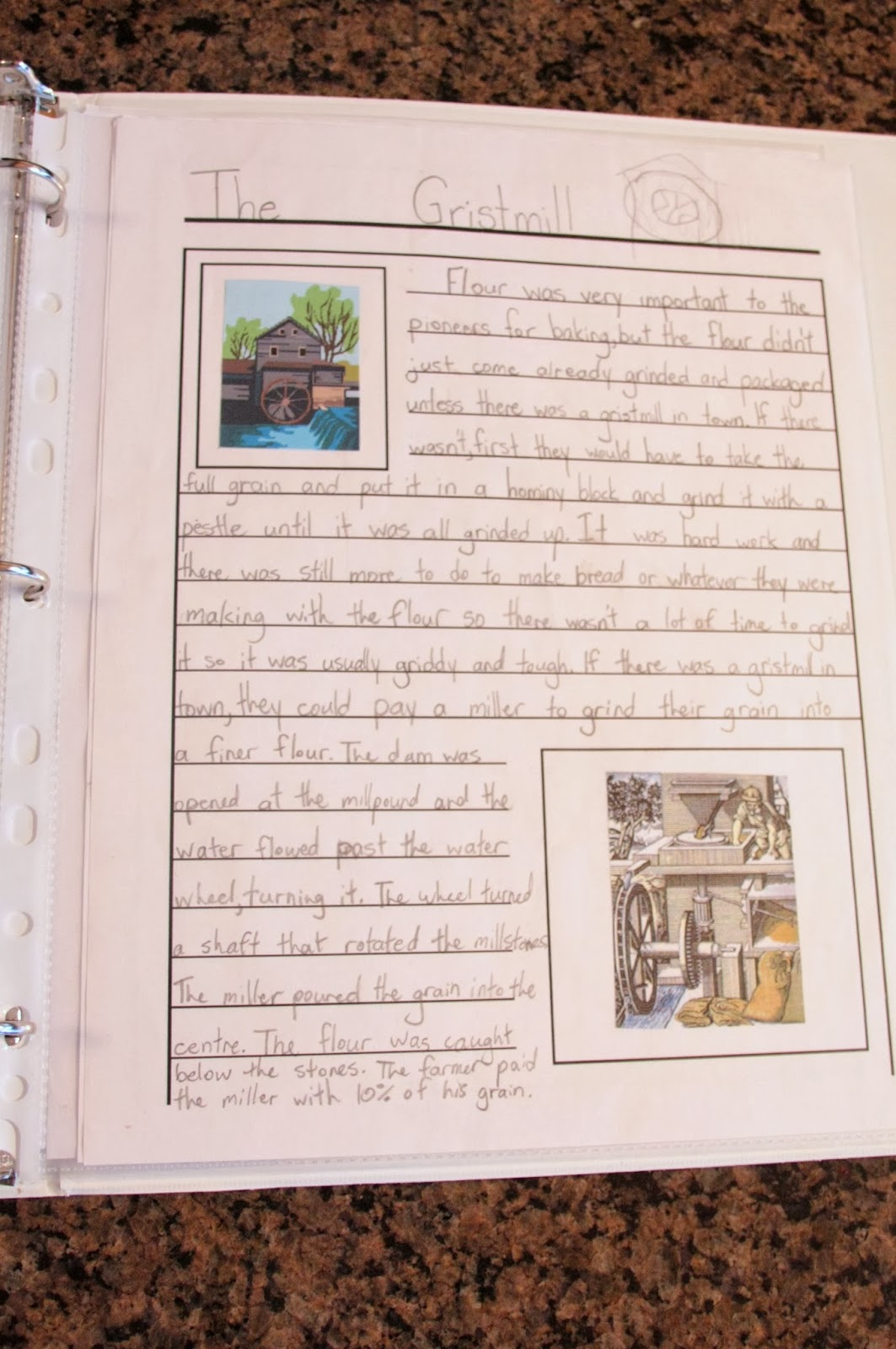
Lapbooking is generally geared to younger students as it includes "foldables" that contain hand-written information about a particular subject. The flaps, accordion booklets, pockets, fans, mini-books and other "foldables" might be designed for short details or for longer descriptions. They can hold pre-printed pictures or spaces for the students' diagrams and drawings. These are then glued into a file folder that has been decorated and most often creased to expand like two windows, opening from the centre. Notebooking is simply pre-printed pages comprising of blocks and lines for drawing diagrams and writing notes on a subject. I love the visual appeal of notebooking and how my kids are proud of their work when they use notebooking pages. Here is a good description of what it actually is and how to utilize it with your children (click on the link). I like to slip the pages into plastic covers from the dollar store, and place them in a three-ring binder.
Notebooking is probably my favourite keepsake of their work.
Sometimes they draw diagrams and sometimes, we print photos of related field trips.
Here, photos of their pioneer day fit perfectly with the short essay she's writing about pioneer children.
Because it's a binder, we alternate lapbook style pieces, notebooking pages, full drawings, essay pages and whatever else will slip into a plastic page protector. It acts as a pocket to hold all the items that go with the study.
 
Here are a few good sites for lapbooking and notebooking:
 
Homeschool Share (for free Lapbooks)
                                      ... to name a few
 
Binders, file folders, project folders (from business supply stores), spiral bound pages are just some of the ways you can contain your children's essays, poems, artwork, history notes, science experiment notebooking, nature notebooking.  
Lapbooks for little ones 
  
 They love how things open and close, fold and turn.
notebooking with downloadable pictures 
with photos that represent the study 
drawings of the subject 
photos of the pioneer craft (because the real thing gets thrown out, or in this case, eaten!) 
write-up about a pioneer working-bee, plus a photo of our actual working-bee dress-up day 
Middles Ages lapbook 
Gold Rush lapbook 
project folder for Ancient Times...
using History Pockets this time (works best for youngest students as it's mainly pre-printed items)
 
Since many of our lapbooks and project notebooks are connected to our unit studies, I'll share where a large part of our inspiration comes from. Several years ago, my sister and I came across a website in which a woman and her sister and her friend designed curriculum around a theme. We were so taken with her style that we have implemented many of her ideas. Her website is called, Courageous Beings: Ignite Passionate Learning and Heroic Living. (watch the second video, especially--truly, it brings a tear to my eye over how glorious it makes homeschooling appear! Lol! Please, always read every site with discernment). You will get an idea of a couple of the adventures we created for our kids here and here (with my sister being the creative and fully-immersed momma).    
 
Finding the right curriculum can be a daunting and overwhelming task as there is an abundance of curricula out there for homeschoolers. Lapbooking and notebooking are ways in which we can incorporate a quick and complete study related to a child's interest when we're unsure of what  the next best curriculum is for our children. It's even great for those who use textbook style learning (or school-at-home). I'll bet you wouldn't guess that my theme-loving sister uses Abeka for several subjects! Although it works well for her family, they would not make it through the year without throwing in a unit study, or two, with some of these components above. Oftentimes, she will replace a chunk of chapters dealing with a biome or historical era with a self-designed, purchased or free  lapbook or notebook project. It makes things just a little more hands-on and fun for the textbook learner. I love how you can use them as your only method of educating or as a supplement. Since so many of these items are free online, it's also an inexpensive and appealing way to teach your children.
 
Tomorrow, I will share photos of our school room :) 

Friday, January 10, 2014

Day Ten: Remind Them How Far They've Come!

I placed their school bins on the floor and called them to open them up before our day began. I had just organized all of their collected work from Junior Kindergarten to the present and since I enjoyed rifling through stick figures and invented-spelling stories, I knew my children would too. As they pulled out paper after paper, the energy was contagious. They laughed at how funny their printing used to be and they showed each other how immature their journals were. They were proud of some of their creative writing and loved seeing the progression in their artwork. 
As we closed up the bins, I asked them how they were feeling. What would they like to change about their work, what were they most proud of and what would they like to see in their bins when they look back next year? Molly loved the self-portraits she had created in pastel each year and remembered we hadn't drawn one this year. She also wanted to write more stories. Emily loved opening and closing all the flaps on her lapbooks and really wanted to complete more of those. Oliver just looked at me and said, "I feel disobedient."
 
I asked him what he meant by that. He answered, "I did such good work when I was little. I need to obey more."
 
Wow, I was surprised. Obviously, my boy knew what he was capable of and that he was not living up to his potential. I was so thankful we had done this little exercise. It was a reminder to me that I had lost my way on completing a few goals, but also, that we had accomplished so much more than I remembered. Needless to say, the rest of the day was quite productive.
 
When our children are struggling with reading or writing, drawing or math, it's so beneficial to show them how far they've come. Do you save your kids' work? I tend to recycle math and spelling books and a few other subjects that have come in the form of workbook style, but I will save a test with a great score or anything else that is a sampling of who they are and what they're producing each year. Awards and certificates end up in the bin as well.
 
My sister shared with me that this activity is a huge motivator for her children and they actually pull out their "old" work frequently. Her son, in particular, will invest more effort into a project after he peruses a project from the previous year. He becomes excited at what he was able to accomplish and doesn't feel as intimidated to start again with something new.
 
Sometimes, it takes a little reminder of how far they've come and some encouragement that they are growing and learning well, no matter how tough it's been. Hopefully, looking back over past years will give us mommas the enthusiasm we need to carry on, knowing we're making progress!
 
Stay tuned as I share tomorrow how lapbooking and notebooking make learning so much more effective and enjoyable in our homeschool.

Thursday, January 9, 2014

Day Nine: Educate In Community

Christopher shifts in his seat as his younger sister squirms on his knee. He's fixated on Matthew's presentation of his computer project but wiggly little Sarah isn't a distraction to him. A mom feeds her baby while nodding encouragement to her kindergartner to smile while reciting her poem. About twelve more kids take their turn at presenting, demonstrating, reciting, acting or reading to our homeschool group and they are mostly respectful and quiet. Later, Jacob, (a highschooler) invites his fellow students outside to witness his homemade potato gun shoot the spuds high into the sky. Everyone is amazed and exclaim with excitement. It's inspirational for the younger children to learn about things beyond their level and the older ones present in almost a teaching fashion. As families pile into vehicles, they leave a little more energized and determined to rise to greater achievements by the next project day.
I desire that my children interact with various ages and all kinds of people. I love how home educating socializes children in ways that being in traditional school all day did not. Our day often includes a trip to the bank, grocery store, nursing home, an activity group for disabled people, friends, relatives, field trips and church. Yes, we had to run errands and add these things into our day while my first two children were in school, but I was painfully aware of how little time I had with them before bedtime and I planned my day accordingly. I worked at completing these necessities before the kids got off the school bus so they didn't get to experience many of these events. With homeschooling, I include my children in these tasks as life lessons, to expose them to their community, and to teach them to love their "neighbour". They are learning to order pizza over the phone, cook a meal, introduce themselves in a group, play a part on a stage, make a doctor's appointment, purchase items with their own money at a check-out, hold a conversation with an adult,  help to open a bank-account, and give to those in need. It's important to my husband and I that our children become independent in their daily living and that includes socialization in real life--their community. They're not there yet but we have a lot of time together to work on it.
 
 
I'm a firm believer that the completion of our schoolwork is very important and must be done as efficiently as possible. Thankfully, if we are diligent, we are able to finish our work early and include fun activities in our day. We will often hang out with other families, which serves the purpose of kid-play and mommy interaction.


When I taught in traditional schools, I was my class's teacher for most of their subjects. What I was not specialized in became another teacher's job, such as music. Home educating is the same and cooperative learning groups are a great support and so much fun. Some co-ops require the parents to teach a class in an area of their expertise, while others, like ours, hire teachers to take on a subject we all agree would benefit our children that term. Educating in communities like co-ops exposes kids to a wide variety of ages and allows them to work at their own level. 
 
Science Centre
Cousins' farm
Science Fair organized by my sister
Another way we educate in community is our own little group that consists of families within a close proximity (of about an hour's drive), as mentioned in the first paragraph. Our children may even work on unit studies together. We've joined science fairs, speech meets, geography fairs and theatre productions together. As moms, we might dress up and play a character from the study we're engaged in or we might ask a friend to be a guest speaker to liven things up! The moms of our group have become great friends and we try to meet in the summer to plan our year and decide if we're interested in any common themes or curricula so we can prepare some lasting memories for our children. Sharing our ideas is one of my favourite aspects to educating in community--great minds teaching me so much!
Jacques Francois from Quebec
My mom does devotional object lessons for our kids.
A Mummer from Newfoundland
Anne of Green Gables from Prince Edward Island
My cousin, Lisa, teaching my children sign language (she worked at a school for hearing impaired people).
 
Community education is beneficial to homeschooled children but not necessarily in large quantities. I still hold fast to the theory that staying at home to complete work and to be together as a family, living and growing, serving each other and learning about life in a safe and loving place is most important. Creating a literacy-rich environment where children can be accepted and grow in Godliness is essential. Working in community, just like using spontaneous moments, requires prayer and discernment so you and your family don't get pulled in too many directions. When it's just the right place for you to be, it's a wonderful addition to your homeschool.